Application in Robotic Welding
Multi-angle welding operation
Hollow rotary platform can be installed on the robot's end effector, which makes welding torch or welding tool achieve multi-angle rotation. By controlling rotation angle of the platform precisely, robots can adjust welding position flexibly and adapt to welding requirements of complex workpieces. For example, on the multi-face welding of automobile bodies, aerospace components and other items, hollow rotary platforms ensure accuracy and consistency of welding path and improve welding quality.
Solving wiring challenges
The hollow structure allows the cables, gas hoses, etc. to pass through the center of hollow rotary platform, which avoids the problem of cable entanglement in traditional rotating mechanisms. This not only simplifies the wiring design of robots and reduces the risk of malfunction due to cable friction and pulling, but also improves the reliability and maintenance convenience of equipment. Especially in welding scenarios of high-speed and frequently rotating, its advantages are evident.
Improve welding accuracy
Hollow rotary platforms usually have high-precision positioning capability, and the repeatability positioning accuracy can reach 5 arc sec or even higher. During the welding process, high precision ensures that the relative position between welding torch and workpiece can be controlled precisely. This feature will reduce welding deviation and improve the quality and stability of weld seam, which can meet the stringent requirements for welding accuracy in high-end manufacturing.
Enhance the flexibility of robots
Compared to traditional welding devices with fixed angles, hollow rotary platform expands the robots' range of motion and operational flexibility. Without changing its own position, the robot can complete welding for different parts through the rotation of hollow rotary platforms. Hollow rotary platforms make robots reduce times of movement and their complexity of path planning, which enhances welding efficiency. Hollow rotary platforms are especially suitable for welding tasks involving large workpieces or complex structures.
Adapt to special welding process
In some special welding processes, such as laser welding, arc welding, hollow rotary platform cooperates with sensors and control systems and realize real-time adjustment and optimization of welding parameters. For example, through the rotation and positioning of hollow rotary platforms, robots can control the relative angle and distance between laser beams or electric arc and workpieces, which improves energy utilization rate and penetration control accuracy of welding, meeting the requirements of special materials or high-precision welding.
Structure and Principle
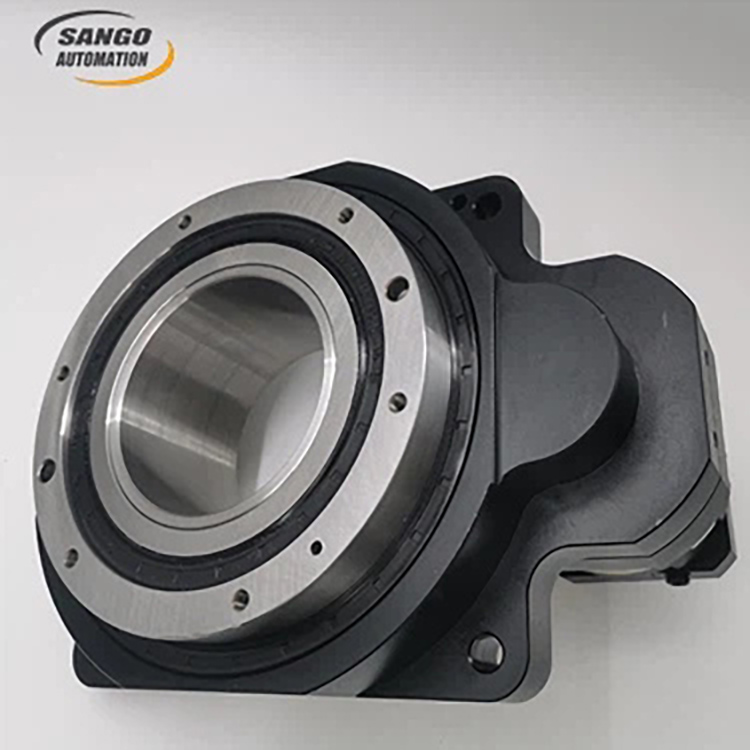
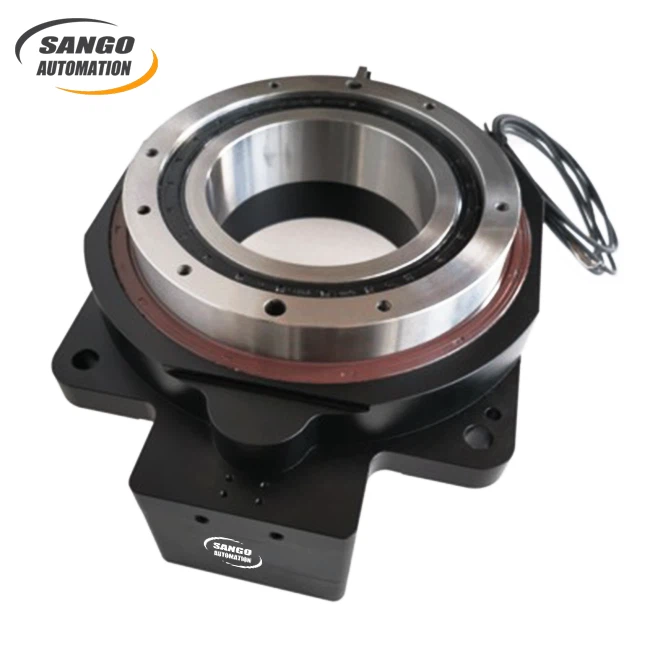
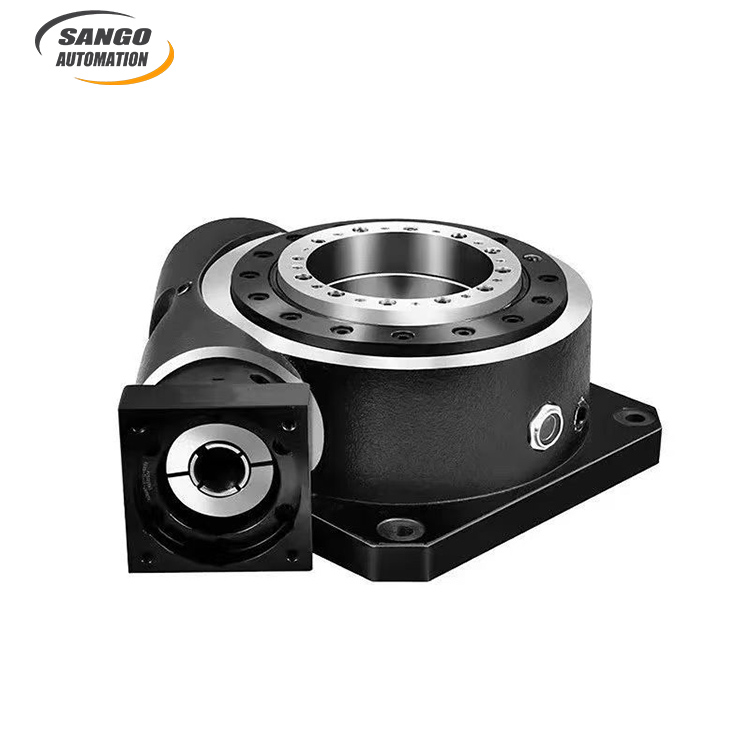
Hollow design: The platform center is equipped with through-holes, allowing welding torch cables, gas hoses, and other pipelines to pass through. This has avoided external wiring entanglement and enhanced compactness and reliability of equipment.
High-precision positioning: Hollow rotary platform utilizes precision transmission components such as crossed roller bearings and helical gears, the repeatability accuracy can reach 5 arc sec to 15 arc sec, ensuring the precision of welding points.
High rigidity and load capacity: Through the pre-tightening design of crossed roller bearing, the rigidity is 5-10 times higher than that of traditional bearings. This makes hollow rotary platform can bear the weight of over 800kg, which adapts to the heavy-load requirements of robotic welding.
How to select a hollow rotary platform
Key selection points for robotic welding
Load capacity: Select suitable model based on the weight of welding workpiece and welding torque.
Accuracy requirements: For high-precision welding, it is necessary to choose hollow rotary platforms with a repeatability positioning accuracy 15 arc sec.
Hollow pore diameter: According to the diameters of welding torch cables and gas hoses, selecting the appropriate through-hole size (common hole diameters: 28 to 250mm).
Provide working conditions of your equipment
1. Weight of loading
2. Diameter of turntable
3. Max speed. Or how many seconds to rotate how many degrees?
4. Drawing or photo of your applicaiton
5. Horizional, vertical or suspension installation?
6. Quantity

 Guangdong, China
 Send Email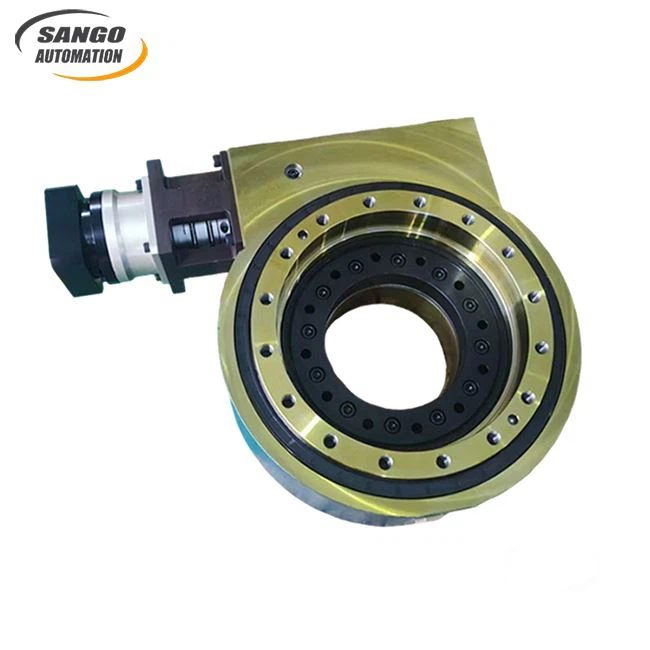

 Send Inquiry



 Send Inquiry


 English
 Spanish
 French
 German
 Italian
 Chinese (Simplified)
 Japanese
 Korean
 Arabic
 Portuguese